
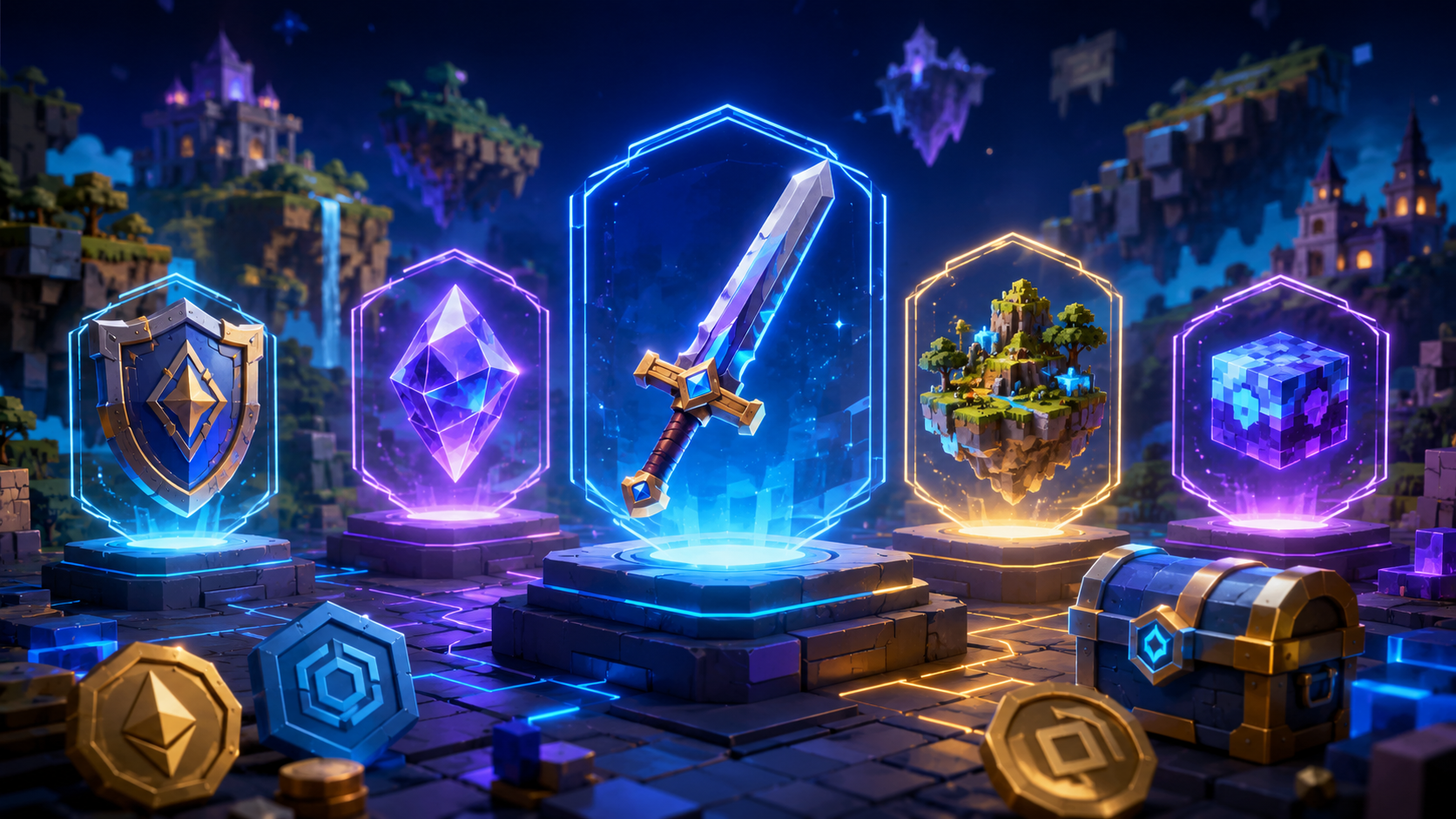

In this article, you will understand what NFT games are, how they work technically, what monetization models are available, the real risks that exist, and how to evaluate whether it’s worth entering this market.
Imagine earning real money by playing and being the sole absolute owner of every item you achieve within the game. NFT games have turned this idea into reality for millions of people around the world, creating a new economic model where time invested in entertainment can generate digital assets with real market value.
Most players have already experienced the frustration of spending hours earning a rare item in a game, only to see the account banned or the server shut down and everything disappear. NFT games attack exactly this problem: they transfer ownership of the game’s assets to the player, permanently and verifiably.


What are NFT Games and Why Are They Changing the Logic of Games?
NFT stands for Non-Fungible Token. To understand the concept, think of a numbered concert ticket: it represents a specific seat, cannot be exchanged for another ticket equivalently, and only you own it. An NFT works with the same logic, but in the digital environment.
Technically, an NFT is a unique record stored on a blockchain, a distributed, immutable, and public database. This record proves that a certain digital asset belongs to a specific wallet address. There is no way to falsify or duplicate this ownership.
How does this change games?
In traditional games, you may “own” a legendary sword or a rare skin, but this possession is an illusion controlled by the developer company. If the server closes, the item disappears. If your account is banned, you lose everything. You never had real ownership, only a license to use.
In NFT games, each valuable item exists as a token on the blockchain. This means:
The item belongs to your wallet, not to the company’s server
You can sell, transfer, or trade the item outside the game
The item’s transaction history is public and verifiable
The rarity of each item is defined by code, not by the company’s promise
This structural change is what separates NFT games from conventional games. Ownership stops being virtual and becomes sovereign.
How NFT Games Work in Practice
The architecture of an NFT game combines three technological layers: the game itself (interface, mechanics, servers), the blockchain (where assets are registered), and digital wallets (where the player stores and manages their tokens).
Blockchains most used in NFT games
Different networks support different game ecosystems. The main ones are:
Ethereum — the most established, with the greatest liquidity, but with historically high transaction fees (gas)
Polygon — an Ethereum layer 2, with fast and cheap transactions, widely used in mobile games
Solana — high speed and low cost, popular in games with many transactions per second
BNB Chain (Binance) — strong presence in play-to-earn games in the Asian and Latin American markets
Immutable X — a blockchain created specifically for games, focused on NFTs with no gas fees
The role of smart contracts
The functioning of NFT games depends on smart contracts, programs that automatically execute rules on the blockchain. It is the smart contract that defines how many NFTs of a certain type exist, what the conditions are for creating a new item, and how transfers between players occur.
When you buy or sell an item within an NFT game, that transaction is validated by this contract, without human intervention. This eliminates intermediaries and ensures that the rules will not be arbitrarily altered.
Monetization Models: How Players Earn Money
NFT games popularized the concept of Play-to-Earn (P2E). But this is not the only existing model. The market has evolved toward more sophisticated and sustainable approaches.
Play-to-Earn (P2E)
In the classic P2E model, the game distributes native tokens or NFTs as rewards for in-game activities, battles won, missions completed, and resources collected. The player then sells these assets on exchanges or marketplaces.
The best-known example is Axie Infinity, which in 2021 allowed players in the Philippines to generate monthly income equivalent to local salaries just by playing. The model, however, revealed a structural fragility: when the price of the native token dropped, the entire game economy collapsed.
Play-and-Earn (P&E)
The evolution of P2E tries to balance the gaming experience with monetization. The focus is on creating a genuinely fun game — where earning is a bonus, not the sole objective. Games like Gods Unchained and Splinterlands follow this philosophy.
Free-to-Play with an NFT layer
Some games are free to play, but offer premium NFT items that can be traded. The player can enjoy the game without spending anything, but by investing time and skill can obtain assets with market value.
Other revenue streams for players
NFT renting: lending characters or items to other players in exchange for a percentage of the earnings
Scholarship programs: guilds that lend NFTs to new players and split the profits
Speculative trading: buying NFTs from promising projects before launch and selling after appreciation
Token staking: locking game tokens in DeFi protocols to generate passive income
See also: Is Limercoin Worth It In 2026? My Experience After More Than 1 Year In The Project
Real Examples of NFT Games and Their Models
The NFT game market includes everything from independent experiments to productions backed by major studio investment. Getting to know the real projects helps to understand the diversity of the sector.
Established games
Axie Infinity (Sky Mavis) was the pioneer that proved the P2E concept at scale. Despite the 2022 crisis, the game survived and launched a renewed version called Axie Infinity: Origins, with a more balanced economic model.
The Sandbox is a voxel-based metaverse where land and items exist as NFTs. Brands such as Adidas, Atari, and Warner Music bought virtual land in the game, validating the model for the corporate market.
Illuvium is a high visual quality RPG with collectible creatures as NFTs. The project stands out for trying to deliver AAA production quality in a Web3 model.
Star Atlas is a space strategy game on the Solana blockchain with a complex economy, where ships and resources are tradable NFTs.
Upland is a real-estate metaverse based on real-world addresses. Upland is known for having made major partnerships, such as with FIFA, for example.
Relevant emerging projects:
BigTime — a multiplayer action RPG focused on fun before monetization
Parallel — a science fiction card game with innovative mechanics
Shrapnel — a tactical FPS that integrates NFTs into gameplay in a non-intrusive way
Risks, Limitations, and How to Safely Evaluate a Project
Entering the NFT game market without understanding the risks is the fastest way to lose money. The sector has historically attracted poorly built, abandoned, or deliberately fraudulent projects.
Main risks
Token volatility: an NFT game’s economy depends on the price of its native token. If that price drops, earnings in real currency plummet proportionally, as happened with dozens of projects in 2022.
Rug pulls: some projects raise capital during the initial NFT sale phase and simply shut down operations without delivering the promised product. The invested money is lost.
Dependence on new entrants: many games with a pure P2E model need new players buying NFTs to sustain the earnings of existing players. It is an inherently fragile structure.
Smart contract vulnerabilities: contracts with code flaws can be exploited by hackers. The $625 million hack on the Axie Infinity bridge in 2022 is the largest documented example.
How to evaluate a project before investing
Before buying any game NFT, check:
Public and verifiable team: anonymous founders are a warning sign
Complete technical whitepaper: serious projects document the entire game economy
Smart contract audit: contracts not audited by companies such as Certik or Hacken represent real technical risk
Sustainable economic model: ask where the money to pay players comes from; if the answer is “from new players,” the model is unsustainable
Active and growing community: Discord, Twitter, and forums reveal the real level of engagement
Existing playable product: avoid investing in projects that still have nothing to play
NFT games represent a structural change in the relationship between players and digital assets. Blockchain technology guarantees real, transferable, and permanent ownership over items that previously existed only under the control of companies.
The P2E model proved that it is possible to monetize time and skill in games, but it also exposed severe economic fragilities when poorly implemented.
The market is in a process of maturation. The projects that survive are those that deliver genuinely fun experiences, with sustainable economic models and competent technical teams.
For the player or investor who wants to participate in this market, research discipline is as important as any skill within the game.
Frequently Asked Questions About NFT Games
What are NFT games?
NFT games are video games that use non-fungible tokens (NFTs) to represent digital assets, such as characters, items, and land, with real ownership registered on the blockchain. Unlike traditional games, the player owns their items sovereignly and can trade them outside the game environment.
Is it possible to earn real money playing NFT games?
Yes, it is possible. Players can earn native game tokens, rare NFTs, and rewards for participating in tournaments or governance. However, earnings depend on the market price of the assets, which is highly volatile, and there is no guarantee of profit.
Do I need to invest money to participate in NFT games?
It depends on the game. Some require the purchase of an initial NFT (character, land, or item) to participate. Others are free and offer the possibility of acquiring NFTs through gameplay. The most recent trend is toward games with free entry and an optional NFT layer.
Are NFT games safe?
The technological concept is solid, but the market has significant risks: fraudulent projects (rug pulls), smart contracts with vulnerabilities, price volatility, and economic collapses of poorly designed games. Safety depends on the quality and seriousness of each individual project.
What is the difference between play-to-earn and play-and-earn?
Play-to-earn (P2E) is the model where the main objective is to generate income through the game, often to the detriment of the fun experience. Play-and-earn (P&E) is the evolution of this model, where the game is designed to be genuinely fun and monetization is an additional benefit, not the central driver of the economy.
Which blockchains are used in the most popular NFT games?
The most used blockchains are Ethereum, Polygon, Solana, BNB Chain, and Immutable X. Each has distinct characteristics in terms of speed, transaction cost, and liquidity volume. The choice of blockchain directly affects the player’s experience and the trading costs of NFTs.
Do a game’s NFT items lose value if the game shuts down?
Technically, the NFT continues to exist on the blockchain even after the game shuts down — you still own the token. However, its market value tends to drop drastically if there is no longer a platform that supports its use. Ownership persists; utility and value depend on the ecosystem.
This content is not investment advice.