

Are you here because you want to know if the Bitaxe Gamma is worth it? Does it actually work? If you’ve ever wondered whether it’s possible to participate in the Bitcoin network without being a massive industrial miner, without spending a fortune on electricity, and without needing a warehouse full of noisy machines, the answer might be sitting right on your desk.
Is the Bitaxe Gamma worth it? That’s the question more and more people are asking, especially those who understand that mining Bitcoin is about far more than just making money, it’s an act of support for the decentralization of one of the greatest financial innovations in human history.
In this article, we’re going to dive deep into everything you need to know about this small but powerful miner before you make your decision.



The Bitaxe Gamma is a compact, open-source ASIC miner built for people who value transparency, autonomy, and making a real contribution to the Bitcoin network.
Equipped with the BM1370 chip, the same one found in Bitmain’s industrial Antminer S21 Pro, it can process up to 1.1 TH/s (terahashes per second), meaning it performs 1.1 trillion attempts per second trying to find the next block on the blockchain.
That might seem small compared to the exahashes the global network processes, but it’s exactly that spirit of individual participation that makes Bitcoin what it is: a network built by ordinary people all over the planet.
Mining Bitcoin solo, at home, with a device like the Bitaxe Gamma, isn’t a guaranteed income strategy, it’s a conscious, low-cost bet that contributes to a freer financial system.
With $2.95 a month in electricity and a real (though small) chance of finding a block and winning over $199,742.38, the Bitaxe Gamma offers something most investments can’t: active participation in the decentralization of the world’s most important digital money.
WHAT IS THE BITAXE GAMMA AND WHY DOES IT EXIST
The Bitaxe project was born out of a community of Bitcoin enthusiasts who noticed a growing problem: Bitcoin mining was becoming increasingly centralized in the hands of large corporations with privileged access to the most advanced ASIC chips.
That’s a direct threat to Bitcoin’s founding principle, being a decentralized network resistant to censorship and to control by any government or company. The community’s response was to create an open-source miner that’s accessible, transparent, and that anyone can build, modify, or audit.
The Bitaxe Gamma is the most refined version of that collective effort, using the BM1370 chip that until recently was only available in high-cost industrial machines.
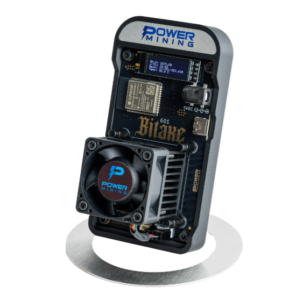
Unlike large miners that consume kilowatts of power, throw off intense heat, and sound like a plane taking off, the Bitaxe Gamma runs on about 18 watts, less than many laptop chargers.
It connects to your home Wi-Fi, has a built-in OLED screen that displays real-time information, and is managed by firmware called AxeOS, an intuitive web interface that lets you monitor temperature and hash rate and configure your mining pool without needing any advanced technical knowledge.
In less than 5 minutes after unboxing it, you can already be mining Bitcoin.
What really sets the Bitaxe Gamma apart from other products on the market is the open-source philosophy behind it. The entire hardware design, firmware, and documentation are public and available to anyone.
That means there are no hidden backdoors, no dependence on a single company for software maintenance, and the community can continuously improve the product.
A portion of the revenue generated by official Bitaxe sales also goes back into ongoing development of the project, which creates a virtuous cycle of collaborative innovation, something rare in the world of mining tools.
HOW SOLO BITCOIN MINING WORKS
To understand whether the Bitaxe Gamma is worth it, it’s essential to understand how solo mining works. Unlike pool mining, where you combine your computing power with other miners and split the earnings proportionally, in solo mining you operate independently.
You point your miner at the network, and it keeps trying to solve the complex mathematical puzzle that validates a block of Bitcoin transactions. If you find the solution before any other miner in the world, you receive the entire block reward, currently more than 3 BTC, equivalent to $199,742.38 (at today’s price).
The probability of your Bitaxe Gamma finding a block is proportional to the percentage it represents of the network’s total hash rate. With 1.1 TH/s and a network that processes hundreds of exahashes per second, the chance is small, but real and mathematically calculable.
What makes this interesting is the comparison with other ways of “trying your luck”: according to community analyses, mining with a Bitaxe Gamma offers 88 times better odds of “winning” than the lottery does in many countries.
The difference? You don’t have to do anything besides plug the device in. No lines, no tickets, no forgetting to buy one, just the device running while you sleep.
In the last 12 months, at least 21 solo miners around the world have found a block individually. That works out to a solo block roughly every 17 days on average, proving it’s possible, even though it’s highly unlikely for any single device.
Beyond the financial chance, there’s an immediate and certain benefit: every hash the Bitaxe processes contributes to the security and decentralization of the Bitcoin network. The more individual miners exist in the world, the harder it becomes for any government, corporation, or consortium to attack, censor, or take control of the network.
When you plug in a Bitaxe Gamma, you’re not just betting on a prize, you’re actively participating in protecting a free global financial system.
See also: How To Earn Bitcoin For Free In 2026 By Creating Content
THE REAL COST-BENEFIT: IS MINING WITH THE BITAXE GAMMA WORTH IT?
This is the central question every potential buyer asks, and the honest answer is: it depends on what you mean by “worth it.” If you’re looking for a guaranteed return on your investment within months or years, the Bitaxe Gamma isn’t the right product for you.
The probability of finding a block with 1.1 TH/s is extremely low, and the mathematical expected gain could take decades, or may never materialize, for an individual miner. That needs to be clear from the start, and the Bitaxe project itself doesn’t hide that reality.
However, if you understand the Bitaxe Gamma as a combination of three things, a low-cost bet with high potential reward, an active contribution to Bitcoin’s decentralization, and an unmatched educational tool for understanding how mining actually works, the product offers surprising value.
With an operating cost of just $2.95 a month and the enjoyment of monitoring your machine’s real-time contribution to the network, many in the community describe it as the Bitcoin equivalent of a lottery ticket you never have to trade in, you just have to keep it plugged in.
The Bitaxe Gamma offers 88 times better odds of a successful mining outcome than a lottery bet, and its monthly energy cost is lower than a single round of betting.
There’s also a scenario that most simple financial analyses overlook: Bitcoin’s own speculative value. If BTC continues its historical trajectory of appreciation, a block reward that’s worth about $199,742.38 today could be worth much more in dollars a few years from now.
Someone who invests in hardware today and operates it at minimal cost is essentially betting on Bitcoin’s appreciation with an exposure that most everyday investors can’t replicate: direct BTC production, with no brokerage fees, no third-party custody, and no mandatory KYC.
WHO IS THE BITAXE GAMMA IDEAL FOR?
The Bitaxe Gamma is ideal for Bitcoin enthusiasts who want to go beyond simply buying and holding BTC, and who want to actively participate in the network as a mining node. It’s also an excellent choice for educators and developers who need a hands-on tool to demonstrate and study how proof-of-work mining actually functions.
CHECK THE BITAXE GAMMA PRICE HERE
Supporters of decentralization who understand that every individual hash contributes to making the network more resistant to censorship and corporate capture will find the Bitaxe to be a concrete way to act on their values.
Long-term Bitcoin investors who want to diversify how they accumulate BTC beyond traditional exchanges, tech-curious people interested in learning about ASICs, firmware, and the Stratum protocol, and anyone looking for a low-cost bet with high potential reward also fit the product’s profile perfectly.
The Bitaxe Gamma is not ideal for anyone looking for guaranteed passive income, anyone expecting to recoup the hardware cost in the short term, or anyone who needs a predictable financial return. Solo mining is, by nature, a game of probabilities, and that needs to be internalized before buying. The device works perfectly; the issue isn’t technical, it’s statistical.
HOW TO SET UP THE BITAXE GAMMA IN 5 MINUTES
The setup process takes less than 5 minutes and doesn’t require any advanced technical knowledge. The Bitaxe Gamma arrives fully assembled and factory-tested. Just connect the included 5V 6A power supply and plug it in.
On first boot, the device creates its own Wi-Fi network. You connect your smartphone or computer to it and access the AxeOS dashboard through your browser, where you enter your home Wi-Fi credentials.
Next, you configure the solo mining pool address, ckpool.org or solo.ckpool.org is recommended, and your Bitcoin wallet address. After saving, the Bitaxe restarts automatically and starts mining.
From there, you can monitor hash rate, temperature, and statistics through the AxeOS dashboard in real time, from any device connected to the same network. For those who want to go further, AxeOS also lets you adjust the chip’s frequency and voltage to fine-tune the balance between performance and temperature.
SO, IS THE BITAXE GAMMA WORTH IT? DOES IT ACTUALLY WORK?
After looking at it from every angle, the answer is yes, with the right expectations. The Bitaxe Gamma works exactly as advertised: it’s a compact, efficient, open-source miner that processes 1.1 TH/s on just 18W of power, costs around $2.95 a month to run, and can, mathematically, help you find a Bitcoin block worth $199,742.38 or more, depending on the timing.
It’s technically solid, well built, easy to set up, and backed by an active, transparent community.
If your expectation is:
Getting rich quick = not worth it Predictable income = not worth it
But if what you want is:
To participate in the Bitcoin network A real (even if small) chance of mining a block To spend little and learn by doing To contribute, more and more, to Bitcoin’s decentralization
Then yes, it’s absolutely worth it.
Because here, the game isn’t just financial. It’s ideological, technological, and strategic.
What the Bitaxe Gamma isn’t, and never claimed to be, is a guaranteed income machine. Solo mining is a low-probability activity, but a real one. Roughly every 17 days, someone in the world finds a block mining solo.
With the Bitaxe running 24 hours a day, you’re always in the race, paying less for it than a streaming subscription, while at the same time contributing to the decentralization of the freest financial system humanity has ever created.
Is the Bitaxe Gamma worth it? Does it actually work? If you’re a Bitcoiner who wants to go beyond just buying and holding, who wants to actively participate in the network, who understands the importance of decentralized mining, and who has the tech curiosity to match, the Bitaxe Gamma is one of the most interesting purchases you can make in this space. Plug it in, let it run, and may the next block be yours.
CHECK THE BITAXE GAMMA PRICE HERE
FREQUENTLY ASKED QUESTIONS
What’s the real chance of mining a block with the Bitaxe Gamma?
The probability is proportional to the percentage your computing power represents relative to the total Bitcoin network hash rate. With 1.1 TH/s and a network processing hundreds of exahashes per second, the chance on any single attempt is tiny.
However, running continuously 24/7, the cumulative probability over time is real, in the past year, 21 solo miners around the world found blocks, which works out to an average of one solo block every 17 days across the entire network. It’s not guaranteed, but it’s mathematically possible and has been proven to happen to ordinary people.
How much does it cost to run the Bitaxe Gamma?
With roughly 18W of continuous power draw, monthly electricity costs run around $2.95 to $4.00, depending on your local electricity rates.
It’s one of the lowest operating costs of any electronic device running continuously.
Is the Bitaxe Gamma hard to set up?
No. The process takes less than 5 minutes. The device arrives fully assembled and tested. On first boot, it creates its own Wi-Fi network, which you use to access the AxeOS dashboard in your browser to enter your network and mining pool settings.
No advanced technical knowledge is required, if you know how to connect a device to Wi-Fi and access a web page, you can set up the Bitaxe Gamma without any trouble.
Is the Bitaxe Gamma noisy? Can I leave it in my bedroom?
The Bitaxe Gamma is remarkably quiet for an ASIC miner. The Gelid 40mm fan runs with a soft hum that’s only audible in very quiet environments and at close range. Many users leave it in their home office or even their bedroom without any issue.
Unlike large industrial miners that sound like a jet engine, the Bitaxe was designed for discreet home use. Under normal operation, the noise level is comparable to a small desk fan.
Is it better to mine in a pool or solo with the Bitaxe Gamma?
It depends on your goal. Pool mining offers small, frequent rewards proportional to your hash rate, you’d earn satoshis regularly, but in very small amounts. Solo mining means betting everything on the chance of finding a full block, no regular income, but with greater potential upside.
Most Bitaxe users who are engaged with the project’s philosophy prefer solo mining, since it contributes more directly to the network’s decentralization and keeps the spirit of individual participation alive. For those who want to see satoshis coming in regularly, pool mining is the better fit.
Is the Bitaxe Gamma really open source? What does that mean in practice?
Yes, completely. The entire hardware design (schematics, PCB files), firmware (AxeOS), and documentation are public on GitHub and openly licensed.
In practice, that means you can audit the code to make sure there are no backdoors or hidden functions, the community can and does make ongoing improvements to the firmware, it would technically be possible to build your own Bitaxe if you had access to the chips, and there’s no dependence on a single company for security updates or support.
It’s a radically different model from the closed-off miners made by major manufacturers.